
Claims that every employee using ChatGPT now needs an AI certificate are misleading. The EU AI Act requires measures that develop AI literacy, but no specific course or official standard certificate.
AI literacy is required—an official standard EU certificate does not exist.
What does Article 4 require?
Article 4 of Regulation (EU) 2024/1689 has applied since February 2, 2025. Following the AI Omnibus amendment, providers and deployers must take measures supporting AI literacy development among staff and other people operating AI on their behalf. Technical knowledge, experience, education, context and affected people must be considered.
Companies do not have to guarantee a fixed level for every person. The duty to support development remains. For the broader risk framework, see the EU AI Act guide for small businesses (Read article).
Does this mean training is unnecessary?
No. Staff should understand what AI is used, its basic operation, opportunities, limitations and relevant legal, ethical and organisational rules. Marketing, IT and HR require different depth. A casual ChatGPT user does not need machine-learning-engineer training.
Does Article 4 apply when staff only use ChatGPT?
Yes. The Commission specifically discusses employees using ChatGPT for advertising copy or translation and says they should know relevant risks such as hallucinations. This may affect marketing, administration, sales, HR, IT, support, editorial, accounting and management.
Use ChatGPT with clear, verifiable prompts (Read article)
Must every employee pass an exam?
No. Article 4 does not require an exam for every person. A voluntary assessment may still strengthen internal evidence: documented training plus a learning check is more meaningful than an unrecorded briefing.
Do I need an official AI certificate?
No. The Commission says no specific certificate is required and organisations may keep internal records of training or other initiatives. There is no legally mandated AI driving licence, AI officer, AI manager or AI literacy card.
Is an AI officer mandatory?
No. Article 4 does not prescribe a governance structure. A voluntary AI owner may still maintain inventories and policies, assess risks, organise training, involve privacy and security teams, and provide a contact point. The title itself is not a protected profession.
Matching product · German-language edition
AI Without the Headache
This German-language SME guide helps build an AI inventory, internal rules, risk assessment and a controlled introduction.
Attendance record, certificate course or personnel certification?
Attendance record
Confirms participation. It can document a literacy measure but does not necessarily include independent examination.
Certificate course
Often includes a test, project, presentation or professional discussion. German IHK certificate courses are one example.
Personnel certification
A certification body evaluates a person against defined requirements. This can be the strongest individual evidence for AI officers, specialists or external consultants.
Where can I obtain certification in Germany in 2026?
Germany-specific: TÜV, IHK and DEKRA are German providers or institutions. Their qualifications are voluntary and do not become official EU certificates. Prices and dates reflect August 14, 2026 and may change.
1. TÜV NORD: AI literacy for employees
The German-language employee AI literacy e-learning covers fundamentals, risks, privacy, governance and responsible use and ends with a test. TÜV NORD lists two training units and currently €85 net/€101.15 gross. The award is an attendance record positioned by the provider as Article 4 baseline evidence—not comprehensive personnel certification.
2. TÜV Rheinland: AI Officer (TÜV)
The German AI Officer course comprises 24 training units covering law, compliance, privacy, risk, ethics, data governance and AI projects. A PersCert TÜV exam leads to a digital personnel certificate valid for three years. TÜV Rheinland says the scheme follows ISO/IEC 17024 requirements. The displayed starting price was €2,555 net when checked.
3. TÜV NORD: AI Specialist (TÜV)
The five-day German AI Specialist programme covers technical, legal and organisational knowledge. Examination requires separate registration. When checked, course and exam were €2,890 and €340 net. Passing the exam and meeting eligibility requirements leads to a TÜV NORD CERT personnel certificate valid for three years.
4. IHK Pfalz: AI Manager
The German IHK Pfalz AI Manager has 60 learning hours and concludes with a project presentation and professional discussion. The checked price was €2,997 per person. An IHK certificate documents structured continuing education; it is not a state-regulated professional qualification or mandatory EU certificate.
5. DEKRA: AI Officer
The German DEKRA AI Officer programme includes a 90-minute, 60-question examination. Successful personnel certification through DEKRA Certification results in a certificate valid for three years. Check the exact course, eligibility, funding and certification variant before booking.
Which route fits which goal?
| Objective | Possible route |
|---|---|
| Occasional ChatGPT use | Baseline AI literacy |
| Document company measures | Standardised employee training |
| Internal AI contact | AI officer course |
| IT or digital responsibility | AI specialist or officer |
| Plan AI strategy | AI manager |
| External consulting | Personnel certification |
| High-risk AI | System- and role-specific training |
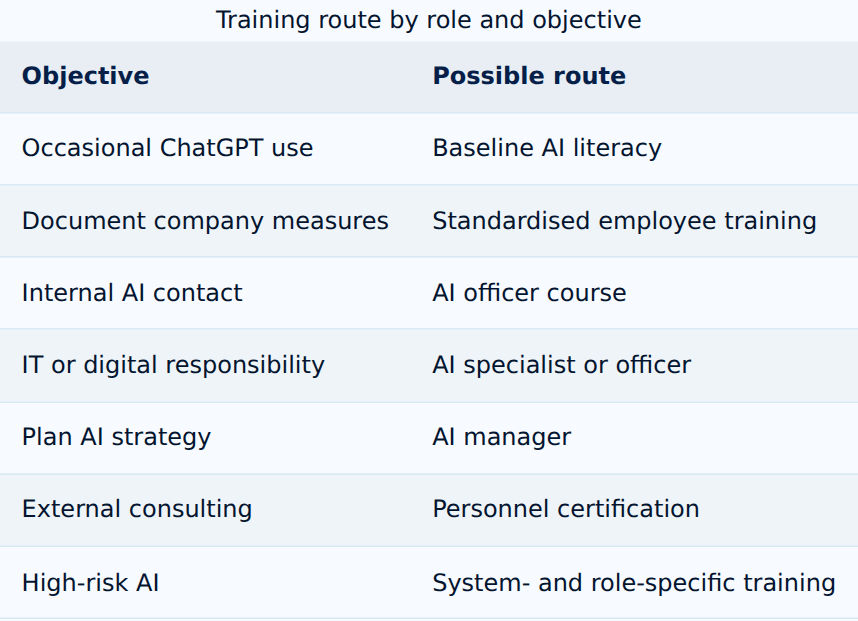
Tap the table to enlarge
Is a two-hour course enough?
It depends. It may suit occasional generative-AI use. It is unlikely to cover administrators granting agents access to servers, databases, email, APIs or customer data. They need permissions, logging, secrets, access controls, data leakage and prompt injection.
Understand security risks when deploying AI agents (Read article)
Matching product · German-language edition
MCP Server Practical Guide
This German-language guide goes deeper into permissions, privacy, tool access and safer agent architectures.
High-risk AI is different
Staff operating high-risk systems must be appropriately trained so human oversight works in practice. A generic introduction does not automatically suffice for recruitment, creditworthiness, biometrics or other sensitive uses.
An eight-step implementation model
- Inventory AI: include ChatGPT, Copilot, Gemini, Claude, local models, agents and embedded features.
- Define groups: users, power users, IT/admins and managers.
- Document needs: systems, purposes, users, risks and required knowledge.
- Deliver baseline training: operation, hallucinations, privacy, trade secrets, copyright, bias, phishing and human control.
- Add role-specific depth: select training matching tasks and systems.
- Retain evidence: record participant, department, systems, date, duration, topics and learning checks.
- Create an AI policy: define approved systems and data, review, approval and reporting paths (full template in this article).
- Update regularly: reassess after changes to models, agents, integrations, threats and law.
No automatic €15 million fine for lacking a certificate
The headline “ChatGPT without a certificate costs €15 million” is false. Article 4 is not included in the specific list attracting that fine tier. Amended Article 99 enables effective, proportionate and dissuasive national enforcement measures, with smaller companies’ economic viability considered.
Enforcement in Germany
Under German law and implementation arrangements, the Federal Network Agency has a central role under the German AI Market Surveillance and Innovation Promotion Act (KI-MIG) and operates an AI Service Desk. Other EU/EEA countries designate their own authorities and may structure enforcement differently.
A pragmatic SME model
Not every employee needs a course costing thousands. Provide baseline literacy for all AI users, deeper training for power users and comprehensive qualification for responsible personnel. This tiered model matches the risk-based logic better than a universal licence.
A certificate is not the same as competence
A certificate demonstrates specified course or examination requirements, not years of practice. Experienced specialists may be highly competent without one. Organisations should still assess system-specific, legal, ethical and organisational knowledge gaps.
Conclusion: evidence of competence, not certificate collecting
Companies must address AI literacy, but every employee does not need a government certificate, no uniform EU licence exists, and an AI officer is not universally mandatory. Ask instead: What competence does this person need for the systems they actually use, and how can development be documented?
Frequently asked questions
Has AI literacy training been required since 2025?
Since February 2, 2025, providers and deployers must take measures supporting AI literacy development.
Do I need an Article 4 certificate?
No. Internal training records and other documented measures are possible.
Do ChatGPT users need guidance?
They should understand hallucinations, privacy and confidential-data risks.
Is there an official EU AI licence?
No uniform legally mandated EU certificate exists.
Must my company appoint an AI officer?
No. A voluntary clear owner can still be useful.
Is TÜV certification mandatory?
No. It may provide independent, examination-based evidence.
Can internal training be sufficient?
Depending on role, prior knowledge, system and risk, it may be.
Must training be repeated?
There is no fixed general interval. Reassess needs regularly and after material changes.
Sources and currency
Status: August 14, 2026. Legal sources: EU AI Act, 2026 AI Omnibus, and the Commission AI Literacy FAQ. Course details come from the linked original German providers. Prices, dates and curricula may change.