
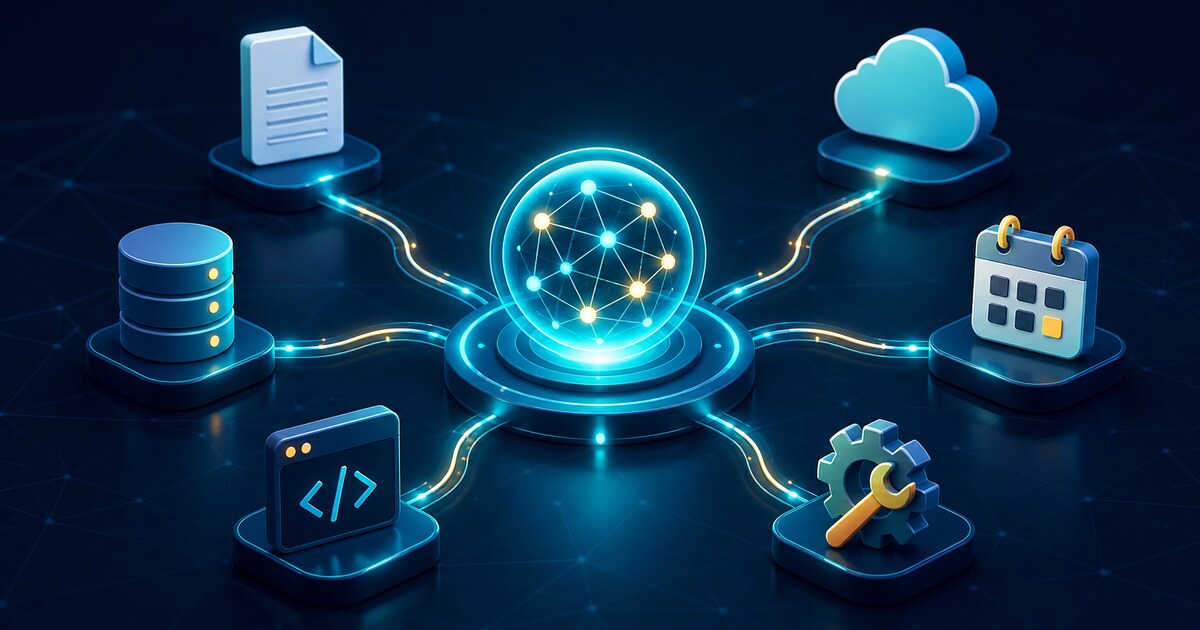
Imagine asking ChatGPT to find a file on your server, an AI to analyze a database, or a coding agent to inspect GitHub and create an issue. The problem is simple: an AI model does not automatically know or have access to those systems.
That is where MCP—the Model Context Protocol—comes in. Instead of building a separate integration for every combination of AI and software, MCP provides a common language.
MCP lets an AI application communicate with programs, data, and tools through a standardized interface.
The official MCP documentation describes it as an open standard for connecting AI applications to external systems such as files, databases, search systems, APIs, and workflows.
What does MCP mean?
MCP stands for Model Context Protocol. Anthropic introduced the open-source standard on November 25, 2024. A language model may understand SQL, Git, and calendars, but that does not mean it can query your database, see your repository, or know tomorrow's appointments. MCP creates a standardized bridge between these worlds.
MCP is a universal connector for AI
Without a shared standard, every AI platform would need separate integrations for GitHub, Google Drive, PostgreSQL, MySQL, Slack, Jira, Microsoft 365, file systems, and internal software. That scales poorly. An MCP server can expose one standardized interface for compatible AI applications.
How does MCP work?
1. MCP host
The host is the application the user works with: an AI chat, IDE, coding agent, desktop app, or business application. It coordinates the model and its MCP connections.
2. MCP client
Inside the host, an MCP client manages communication with one server. A host can run several clients and connect to several servers.
3. MCP server
The MCP server exposes functions or information from a file system, database, GitHub, calendar, ticketing system, API, CRM, or cloud platform. It may be a local process or a remote service.
A simple MCP example
You ask: “Which open bugs are currently in my project?”
- The user asks the question.
- The AI determines that it needs GitHub data.
- The MCP client contacts the GitHub MCP server.
- The server retrieves the required information.
- The data returns to the AI.
- The AI analyzes it.
- The user receives a clear answer.
This turns a chatbot into an assistant that can work with external systems.
What can an MCP server provide?
Tools
Tools perform actions and queries: calling a database or API, creating a file or issue, running a calculation, changing a record, or starting a workflow.
Resources
Resources provide information such as documents, files, database content, configuration, source code, logs, and knowledge bases. The host decides how to use them in the model's context.
Prompts
Servers can offer structured prompt templates for repeatable workflows, such as “Analyze this server log according to our internal security policy.”
Why does MCP matter for AI agents?
A chatbot answers questions; an AI agent is expected to complete tasks. To inspect overnight errors, locate the responsible repository, and create tickets, it may need monitoring, logs, GitHub, and a ticketing system. MCP can provide the standardized connection layer.
What AI agents can really do (Read article)
Is MCP only for Claude?
No. MCP originated at Anthropic, but it is a cross-vendor open-source project. In December 2025 it was donated to the Agentic AI Foundation (AAIF) under the Linux Foundation. Anthropic, Block, and OpenAI co-founded the foundation, with support from organizations including Google, Microsoft, AWS, and Cloudflare.
How are MCP and ChatGPT connected?
OpenAI also supports MCP. Developers can connect remote MCP servers through the Responses API. Subject to configured permissions, models can retrieve internal documents, tickets, and product information or perform actions in connected applications. MCP is not merely a Claude interface.
Not every integration needs a custom MCP server: ChatGPT now also offers ready-made apps for common Google services, see Connect ChatGPT to Gmail, Calendar, and Drive – 2026 Guide (Read article).
MCP versus APIs
MCP does not replace APIs. An API defines how to communicate with a particular service. MCP focuses on how a system presents information and functions to an AI application. An MCP server may use REST, GraphQL, or another API internally. Think of it as an AI-friendly integration layer.
Benefits of MCP
Fewer custom integrations
Developers do not need a completely new connector for every AI-and-data-source combination.
Portability
A compatible source can work with different compatible hosts.
Extensible assistants
Applications gain capabilities without retraining the language model.
Current data
Servers can supply information that is not in model training data.
Automation
Tools can perform actions as well as retrieve information.
Is MCP secure?
MCP does not make every connection safe automatically. Write access to files, databases, and administrative tools increases the possible impact of mistakes or abuse. Use least privilege, separate read and write access, require approval for critical actions, authenticate securely, log activity, segment networks, review unknown servers, and protect credentials and tokens. The specification includes authorization mechanisms for HTTP, including OAuth-based approaches.
Core rule: give an MCP server only the permissions it actually needs.
For a detailed security checklist covering least privilege, sandboxing, OAuth, and protection against token passthrough, SSRF, and prompt injection, see How to Operate MCP Servers Securely: Permissions, Tools, and Risks Explained (Read article).
Matching product · German-language edition
AI Without the Headache
A practical German guide to privacy, access rights, and safer AI adoption in small businesses.
Can I build an MCP server?
Yes. A company can expose selected internal functions to AI. An inventory server could offer find_customer, get_invoice, search_products, check_stock, and create_support_ticket. Official SDKs and development tools are available.
Matching product · German-language edition
MCP Server Practical Guide 2026
This comprehensive German-language guide covers building, installing, and securely operating local and remote MCP servers, including Python, OAuth/OIDC, GDPR, logging, and server automation.
AI coding agents like Codex can be connected to your own tools and remote servers in a controlled way too. Codex CLI & Codex Remote Control on Linux (Read article)
How do clients and servers communicate?
MCP uses JSON-RPC. Local servers commonly communicate over stdio through standard input and output. Remote services can use Streamable HTTP. Most end users do not need this detail, but it matters when developers and administrators operate MCP infrastructure.
What changed in MCP in 2026?
The current specification when this article was published is dated July 28, 2026. Its stateless protocol core makes requests self-describing and improves the scalability of remote services. Other changes include cacheable tool and resource lists, extensions, hardened authorization, Multi Round-Trip Requests, routing, and richer agentic workflows. The official 2026-07-28 release overview also underlines that MCP is an actively evolving standard.
Who should care about MCP?
Developers
They can expose applications and APIs to AI through a common protocol.
System administrators
Monitoring, infrastructure, logs, and management tools can become available under controlled access.
Businesses
Internal sources can be connected to AI with defined permissions.
Software vendors
One shared interface can reduce separate provider integrations.
AI users
Assistants become more useful when they can use permitted, current information and tools.
A practical business example
An administrator asks: “Why has our web server been slow since this morning?” A secured agent could use MCP to inspect Checkmk, HAProxy and web server logs, MySQL, GitHub, and a ticketing system. It might correlate normal CPU usage, higher database latency, unusual traffic on one endpoint, a recent deployment, and a matching commit—then offer a reasoned hypothesis.
MCP connects a model's intelligence to the real working environment.
No-code platforms are adopting MCP too: n8n offers dedicated MCP Client Tool and MCP Server Trigger nodes, letting AI agents use external MCP servers or exposing n8n workflows themselves as an MCP server. Build AI Agents with n8n – No Coding Required (Read article)
Will MCP replace traditional APIs?
Probably not. Many servers will continue to rely on REST, GraphQL, databases, and established technologies behind the scenes. MCP adds a standard layer specifically for presenting functions and context to AI applications.
Frequently asked questions
What is MCP in simple terms?
MCP is an open standard through which AI applications communicate with external data and tools.
What is an MCP server used for?
It exposes resources or tools from GitHub, databases, file systems, and business applications.
What is an MCP client?
It is the component inside an AI application that communicates with a server.
Does MCP belong to Anthropic?
Anthropic created MCP and donated it to the AAIF in late 2025.
Does ChatGPT support MCP?
OpenAI supports remote MCP servers in developer scenarios including the Responses API.
Is MCP an API?
No. It is a protocol, although its servers may use APIs internally.
Can MCP access databases?
Yes, when a server exposes selected queries or functions.
Can AI take actions through MCP?
Yes. The server and permissions define which actions are allowed.
Is MCP free?
The protocol is open; connected services may charge fees.
Conclusion: MCP could become a key interface for AI
A capable model becomes much more useful when it can access the information and tools required for a task. MCP supplies a common interface between AI, data, and tools. It can help assistants research, analyze files, query databases, use applications, start workflows, and coordinate work across systems.
The central question is no longer only “How intelligent is the model?” It is increasingly “Which systems, data, and tools can it access?” MCP offers one of the most important answers.
Matching product · German-language edition
Create Your Own AI Skills
German templates and checklists for reusable AI workflows—a practical complement to tool-enabled assistants.
Further reading and sources
How plugins, skills, and MCP servers work together (Read article)
Claude Code vs. OpenAI Codex: how both coding agents use MCP (Read article)
How to review AI output and automated actions safely (Read article)
Current as of August 2026. Primary sources: Anthropic's launch announcement, the MCP 2026-07-28 specification, MCP architecture, MCP authorization, and official OpenAI remote MCP documentation.
What Permissions Should an AI Agent Get? Security Rules for Agents (Read article)
Build Your Own MCP Server: Architecture and a Python Example (Read article)
AI Skills, Plugins, Apps, and MCP: What's the Difference? (Read article)